
Tata Sons' dividend from Tata group companies for last financial year is expected to show a decline of 3.5 per cent to Rs 36,514 crore from Rs 37,832 crore a year earlier. This should be the first year-on-year decline in Tata Sons' dividend in the last nine years. The holding company had last reported a decline in FY16, when its proceeds had gone down 42.5 per cent to Rs 6,898 crore from Rs 11,993 crore a year earlier.

Revenues from Bangladeshi patients have declined by 30% to 35% in 2024-2025. Bangladesh typically accounts for 70% to 75% of all medical visas issued by India.

Data since 2005 show that the five years with the highest rainfall saw average market returns of 8.98 per cent, while the five driest years returned 25.7 per cent on average.

The political and ideological differences between the Congress and Shashi Tharoor is no longer a matter of whispers.

Fada estimates that global supply chain headwinds like scarce availability of rare earth elements for electric vehicle components and geopolitical tensions may affect urban consumer sentiment in June as well.

If Rakesh Sharma represented the dreams of a nascent India looking outward, Shubhanshu Shukla embodies a confident India reaching for the controls.

The company has embedded intelligence in every layer of its value chain, marked by predictive maintenance, AI-powered image recognition and robotic automation.

40 Covid patients died since mid-May, which is more than the total number of deaths over the preceding 39 weeks.

'Illegal gambling operators are systematically exploiting India's advertising and payment infrastructure, siphoning off crores of rupees from outside the country.'

Lacking basic safeguards and regulations, India is fast emerging as a hub for illegal online betting and gambling market, with the top 15 such unauthorised platforms logging an alarming over 5.4 billion visits in FY25, according to a report by public policy think-tank on consumer sovereignty.

The country's biggest carmaker, Maruti Suzuki India, has raised concerns about the continuing slide in small car sales.

There have been more instances of a management team buying out the owners of a company after the pandemic. There are eight such transactions, called management buyouts (MBOs), in the five years ending 2024, according to data from tracker LSEG shared with Business Standard.

There have been multiple instances of the same entity appearing as both a public shareholder as well as under the promoter classification in some listed companies. And this dual-classification happened in the same quarter, according to data compiled by primedatabase.com.

Banks have outperformed the broader market in the past six months and most of the leading lenders have given positive returns to investors compared to a negative return delivered by benchmark indices.

The share of investments held by the top 10 investors across smallcap mutual fund schemes has been on a decline, falling to a 14-month low in March 2025, shows an analysis of data from the Association of Mutual Funds in India (Amfi). The median smallcap scheme has 2.03 per cent of its investments coming from the top 10 investors, compared to 2.43 per cent a year ago.

Early-bird results for the January-March 2025 quarter (Q4FY25) suggest a slowdown in earning growth for India Inc, despite a benign cost environment that has led to an improvement in margins. The combined net profit (adjusted for exceptional gains and losses) of 175 early-reporting companies rose by 3.8 per cent year-on-year (Y-o-Y) in Q4FY25, marking the slowest growth in 17 quarters.

'Amaravati will be a game changer for Andhra Pradesh.'

Tata Consultancy Services (TCS), the country's largest player in information-technology (IT) export, has seen a sharp decline in its contribution to the Tata group's market capitalisation in recent years though it remains the most valuable company in the conglomerate. Its 44.8 per cent share in the combined market capitalisation of the listed Tata group companies is the lowest since March 2009 and is down sharply from the all-time high contribution of 74.4 per cent at the end of March 2020.
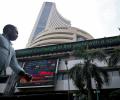
Like with all great crashes, some had noticed the cracks. "... cash balances (of banks) seem, from the available indications, to be hopelessly inadequate; and it is hard to doubt that in the next bad times they will go down like ninepins. If such a catastrophe occurs, the damage inflicted on India will be far greater than the direct loss falling on the depositors," said John Maynard Keynes in his May 1913 work "Indian Currency and Finance", written before his path-breaking work in macroeconomics laid the foundation of dealing with global crises.

 © 2025 Rediff.com - Investor Information - Advertise with us - Disclaimer - Privacy Policy - Sitemap - Feedback - About us - Terms of use - Grievances